The Hope For the World

“Nobody cares about orphans in this country.  The Christians don’t want to get involved and everyone else pretends they don’t exist”  This was the criticism I heard from the director of a Ukrainian para-church organization 3 years ago after spending a heartbreaking and life-changing week with Ukrianian orphans.

I’ve never felt more hopeless than after leaving the orphans I had fallen in love with, knowing that 70% of the girls would end up involved in prostitution and most of the boys would end up in prison or addicted to drugs living on the streets.  Who would care for them?  Who would lift them out of poverty and hopelessness and teach them how to live.  No one.

That was 3 years ago.  In my opinion, the game has changed.  Along with me in that orphan camp 3 years ago was a Ukrainian pastor named Sasha who, to be honest, seemed to be there against his will.  He was the speaker for the camp but he didn’t seem to enjoy it at all.  He also seemed rather unwilling to engage the orphan children relationally.

But, when we returned to the camp the following year, he was waiting for us along a bunch of people from his church.  There could be no doubt, he was a different person.  His entire demeanor was different.  He had fallen in love with orphans.

As it turns out, he experienced the same haunting feelings of hopelessness and felt compelled to become more involved in orphan ministry.  Here was a man fighting against the cultural tide and leading his church to do the same.

Our second year of ministry with the orphans was amazing because we served as the body of Christ.  The Holy Spirit overcame 7 time zones, national borders, and language and cultural barriers to produce amazing camaraderie between Americans and Ukrainians.  It was a beautiful experience.

Some of these Ukrainians reordered their entire lives to serve orphans.  One young woman began visiting the orphans every weekend.  Now she’s teaching cooking classes in the orphan school, developing relationships what will endure as the kids exit the school and enter the real world.

Last month, I returned to Ukraine alongside 23 friends from our church.  This time, 25 Ukrainians from 3 different churches met us.  The passion of these Ukrainian Christians was deeply evident.  They led the way in all aspects of the ministry.  In three short years, everything has changed.

A few days after our orphan camp experience, I met a young pastor near Kiev whose passion for orphan ministry blew my mind.  I fought back tears as he described how his entire church is training to become mentors for orphan kids.  Their church is welcoming the orphans into their community with open arms.  They are teaching them vital life skills and connecting them into small groups.  The people from this church are setting up ministries at the local technical schools—where the orphans go after their time in the orphanages is complete.  The church is even putting on its own summer camp for orphan school graduates.  I honestly couldn’t believe what I was hearing.  His vision and model for ministry is amazing.

I also met a woman who, because of her orphan camp experience, plans to leave her medical practice and set up a transition home for orphans.

3 years ago I left Ukraine utterly hopeless.  I cried for weeks and even experienced terrible nightmares about the bleak futures awaiting these orphan children.  This year, I left with a powerful sense of hope.

God is in Ukraine.  God is moving in His people and His people are responding.  They are loving and equipping orphans.  God’s people are doing incredible work.  This is the church.  The church truly is the hope for the world.  When the church does what it was designed to do, it is beautiful, compelling and transformational.  I, for one, am very proud to belong to the church of Jesus Christ.


Confusing Motion With Fruit

Recently, I heard from a youth worker I haven’t seen in a long time.   They were carrying on about how busy their summer was.  They were bragging of the 17 trips and events that they are bringing their junior high ministry kids on this summer.  After this conversation, I really felt called to take a nap.   I was tired.

After i thought about it, it began to make me sad that this veteran of youth ministry was still under the notion that having a flurry of activity was critical to making disciples.  Maybe I am just getting old, but I tend to disagree.  Those of us in youth ministry have tended to replace discipleship with events.

Don’t get me wrong, I think some events are helpful and even help with kids becoming more like Jesus.  But, I also believe that it’s time that we slow down and make more progress towards conforming kids to the image of Christ. Our goal in youth ministry is just that, that the kids God has called us to reach, become more like him.   Over the years, there have been some helpful thoughts and questions that need to be considered before we fill up our schedules.

1.  Make sure the event builds the mission.  Instead of just planning an event, make sure you have the relational element.  Instead of just taking kids to an amusement park, make sure kids are experiencing this event in small groups with a godly adult mentoring and building relationships along the way.

2.  Give parents tools to use to disciple.   Many times we feel like we can do better than parents (unfortunately we are correct in some cases), but we God has given a powerful responsibility to disciple our own kids.  By building into parents we can free up the youth ministry schedule and equip them to spend time with their kids in a redemptive way.

3.  Less is often more.   I like to be busy.   It feeds our egos, makes us feel irreplaceable and even keeps us from focusing on our own spiritual walk, but we must change our paradigm.  A few quality experiences seems to have so much greater value than taking our kids in multiple directions.

I would suggest that we take a hard look at the craziness our schedules have produced and evaluate the fruit of our ministry calendars.   I can’t help but think of John 15:2 that says  “He cuts off every branch in me that bears no fruit, while every branch that does bear fruit he prunes so that it will be even more fruitful.”  Maybe its time to get out the pruning shears and see more fruit and less motion.


Dan Kregel has served as the Executive Director of GRMYFC since 2007.  Dan previously served as the Pastor of Student Ministries for about18 years at Calvary Church in Grand Rapids, MI.  Dan serves on the Board of Trustees for Youth Ministry International (which trains Youth Workers all over the world) and the S-Factor (A local ministry that teaches kids about sexual purity).  Dan has also written many articles on Youth Ministry including for Youthworker Journal.  Dan studied at Moody Bible Institute, Grace Bible College and Cornerstone University.  He is currently working on a Masters degree in ministry leadership. Dan lives in Grand Rapids and is married with four Children where he serves at his church in the student ministries department.  You can read his blog here.

A Spy Mission and a Broken Heart

Spies are so compelling.  Given the chance, I’d be a spy in a second.  All that intrigue, danger and secrecy—so good.

Last week I was in Ukraine on a little spy mission of my own.  A few weeks ago I shared the story of our failed adoption of a Ukrainian orphan girl.  You can read the story here.

Basically, some friends and I have fallen in love with a group of orphans who we met in a camp in Ukraine—my wife and I attempted to adopt one of these kids.  For whatever reason, she and the rest of the kids have been moved to a different camp in which we Americans are not allowed to visit.  We repeatedly pleaded with the director of this camp to be able to visit but he would not consent.  In fact, when we asked one final time he said he would never let us and then slammed the phone down on us.

The thing is:  I love that girl and the other kids who are with her.  So, we decided to throw down a spy mission.  My good friend Oleg who happens to be the director of Radooga was kind enough to drive us to the camp.  We contacted everyone we could and asked them to pray and then drove for 2 hours to her camp knowing full well that there was basically no chance of being let in.   On the way, we called one of the kids in the camp and let him know we were coming.   We were worried about the kids sneaking out and getting in trouble but we just had to try.

As it turns out, God opened the way for us because when we arrived the director of the camp was attending a camp-wide concert.  While he watched the show a few of the kids slipped out to see us, including the girl I came to see—the girl who was so nearly my daughter.

As we drove up to the gate the kids were jumping down with excitement and mobbed us as we exited the van.  It was a tremendous joy to see these kids that we love so much—especially the girl we almost adopted.  She never let go of me the entire time we were there.  We cried over the separation and laughed as we looked at pictures and took a few new ones.   We talked about our memories together in camp and bragged about how our team was the best.  And then, after what seemed like only a few minutes, it was time for the kids to go.

Before she walked back to her dorm, she pulled me and a translator away from the crowd and utterly broke down.  Through her tears she apologized for declining our adoption.  She said she decided to stay in Ukraine so that she could care for her alcoholic mother.  But, only a month after she said no to us her mother hanged herself.  It was horrible and now she is terribly alone, utterly abandoned and regrets everything.

I held her, wiped away her tears and told her how sorry I was.  And then, her counselors called her away.  I kissed her forehead, told her that I loved her and she was gone.

It’s been a week and I just can’t escape that encounter.  I just keep replaying it in my mind.  There is nothing we can do to adopt her.  It is too late.  She’s too old.  But, she doesn’t understand and frankly neither do I.  I usually appreciate laws that protect our country but in this case I hate them.

She has no one.  Both of her parents are now dead.  Her older brother is in prison for the next decade and the rest of her extended family has abandoned her.  My heart aches because she was so close to becoming our daughter—so close to safety, love and security.

And then I decided, “Who cares?  Who cares about laws, borders and language barriers?”  She needs a father.  For whatever reason God didn’t allow us to adopt her but I can be a father.  I can support her, love her and empower her from a distance.  And so, that’s what I’m going to do.

I’ll never understand why things have worked out the way they have.  It will always break my heart and I’ll always worry about her but I will never give up and I’ll never stop trying to be a father to her.  Why?  Because that’s exactly how God treats me.  How could I not attempt to do the same for her?

How Safe is Your Student Ministry?

I hate rules. I really do. I’m still not sure how I survived the rule rich environment of Moody Bible Institute. I think it’s because somewhere along the way I recognized the value of boundaries.  Let me explain with a story…

As a young youth pastor in my first position, we embarked on a yearly sojourn to Cedar Point–if you’re not from the Midwest, this is a massive amusement park filled with roller coasters, fried everything you can imagine and the highest mullet per capita anywhere.

After an epic day of G-forces, sunburn and chasing down make-out-minded teenagers, we would arrive back at the church at 11:00 PM and I would wait FOREVER for parents to pick up their kids. I know you’ve been there. On this particular night, I was more than a little exhausted and one girl’s parents had still not shown up after 45 minutes. I called her house and woke up her dad who mumbled something about having to work at 4 AM, a missing car and something else that I didn’t hear because I was so angry.

In frustration and exhaustion I drove her home myself. Fail.  At the time I didn’t realize how bad this idea was.  In fact, at this point in my career, I regularly met with female students, leaders, and parents one-on-one in coffee shops–sometimes even driving alone with them. I just thought that’s what a youth pastor did.

I didn’t think much about how dangerous these meetings were until a few years later when one of the girls in our ministry invented a story about a fictitious guy who had raped her. It took months for law enforcement to sort out that she was lying but an enormous amount of damage had been done to her reputation.

This is when it hit me that she easily could have made that story up about me or one of my volunteers.  Any number of the troubled students I worked with could have invented a story that involved me. Suddenly, I realized the precarious nature of my role.

One student could destroy my career and life with a few well timed lies. And yet, I firmly believe that God has called me to serve these students.  What to do?

How do we balance our calling with protecting ourselves and those who serve with us? We must serve smarter. We need to place boundaries around ourselves, our volunteers and our ministries.  I hate rules but we must face reality.

Our church and student ministry has spent the last few years thinking through these difficult questions, sometimes against our will.  Here’s a list of precautions we take. I encourage you to think through the list and consider how vulnerable your ministry is.  Also, please add anything you feel is missing.

One-on-One Meetings

  • We do not allow our staff or volunteers to do one-one-one meetings with the opposition gender–not even in public places
  • We document every one-on-one meeting between an adult and student
  • We require parent approval for every one-on-one meeting
  • We ensure that another volunteer or staff member knows in advance about each one-on-one meeting.

Troubled Students and Abuse

  • We have brought CPS and law enforcement representatives into our staff and volunteer training meetings to create clarity about mandatory reporting.
  • We have created clear lines for when a student has become a threat to the safety of our students and we regularly ask students to take a break from our ministry.
  • We have a professional counselor on our staff who guides us through every difficult student or family issue that we face. This person connects us with other professional counselors or services when needed.

Security

  • We have a security coordinator who is a former law enforcement officer who constantly evaluates and advises us on security issues.
  • We background check every adult who is present during our weekly programs.
  • We lock our doors before and after check-in and during the entirety of our program.
  • We have trained security personnel present at all of our events.

I understand that this stuff is about as fun as a root canal but it is important and necessary.  We must create safeguards because they protect the integrity of our ministries and they build trust with students and parents.

So, what are your safeguards?


Photo by Calignosus


LifeLine is Hiring

Have you ever thought, “Wow, I’d really like to work with Aaron.  He just seems so smart and trendy.”  The truth is, I’m not that trendy and I only seem smart because I steal all my coworkers good ideas and pretend they are my own.  However, we are hiring.  And, we’re not just hiring one person in our student ministry department, we’re hiring 4 full-time and 1 part-time positions!

I’ll be honest, our student ministry is awesome and our staff is a riot.  So, if you are looking for meaningful work and a fun community to serve with, we should probably talk.

If I’ve captured your curiosity, here is a little about Ada Bible Church and LifeLine:

  • We are a multi-campus Bible church of around 9,000 people.
  • All of our campuses are located near Grand Rapids, MI.
  • Our student ministry is built around small groups.  Our volunteers are amazing and our community is exceptional.
  • We take a family ministry approach.  Sometimes we even think Orange.
  • We love simplicity and excellence.  We don’t do a ton of stuff but what we do is high quality and strategic.
  • Our student ministry team is currently at 7 full-time and 3 part-time.  Once we are finished hiring, we will have 9 full-time and 3 part-time.

If you’re interested in joining the LifeLine team, you can apply for the positions on our job board.  If you aren’t currently looking for work but know of an exceptional youth worker who is, please pass this information along.  Also, feel free to leave a comment or email me with any questions you might have.


Photo by Piero Sierra

Wanna Be a Great Youth Pastor? Get a Real Job.

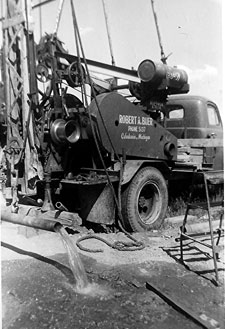
img_drilling-1957-with-new-rigI come from a long line of men. I’m talking about rugged, leather skin, strong as an ox, men.  I’m a 5th generation water well driller.  We work outside all day every day, rain or shine, winter and summer. It’s hard, dirty and more than a little dangerous.

You might say I put in my time as a well driller.  I started in the shop in early middle school and finished up at 23.  I’m actually very proud of the 11 wells that bear my name in the Michigan water well database. Never mind that my dad probably has a couple thousand under his name.  What’s a couple extra zeros?

To be honest, I was never going to make it has a long-term well driller.  I’m about as mechanically inclined as a sloth.  I can’t fix anything.  Also, my frail body was already starting to fall apart after only a few years of full-time drilling—tendonitis, tennis elbow, carpal tunnel, etc.   It’s a little embarrassing but who’s going to argue with weak genes?

Obviously, I diverged for the family tradition path but not because I didn’t like the work or the industry.  I’m actually very grateful for my heritage and experience drilling wells.  Much of what I learned has impacted who I am as a youth pastor.  Let me explain:

  • Ingenuity

I know this sounds a little like “My dad can beat up your dad” but when it comes to problem solving my dad is a genius.  He never gives up and he thinks outside the box.  Our family business wasn’t exactly rolling in the deep so we often had to create our own solutions.  My dad built his own tools and gadgets.  He was always tinkering with his systems to push for more speed and greater accuracy.

Like I said before, I can’t “fix” my way out of a wet paper bag but I did learn ingenuity from my dad.  I love to evaluate our programs, systems and strategies.  Never be satisfied.  Always push for greater effectiveness.

  • If You’re Not Having Fun, You’re Not Doing it Right

Here are some things that don’t mix well:  water, wind, winter, me.  But that’s exactly what being a well driller during the winter is like.  When it’s freezing cold and you’re standing out in a field exposed to the biting wind getting repeatedly splashed by water you can either hate your life or laugh.

For years I worked on a drilling crew with a guy named Dennis who was hilarious.  We spent all day every being ridiculous, joking around and generally having a great time.  What I learned is this, don’t take your work so seriously that you can’t laugh and have a ridiculously good time.  It’s just not worth it.

  • Work Ethic

There’s nothing about well drilling that is easy.  My dad taught me to work and to work hard.  Sadly, most of us in youth ministry aren’t known for our killer work ethic.  Working hard and being accountable for your time are great ways to build trust among parents and church leaders.  My recommendation to anyone studying to become a youth worker is to learn how to work.  If necessary, get a “real job” before launching out into student ministry.  It might be the best ministry training you ever get.

To summarize, what many would consider a lowly, undesirable, manual labor job has taught me valuable lessons about what it means to work.  I’m immensely proud of my heritage.  Sometimes I think my time as a well driller may have even been better training than my degree in youth ministry.

Guest Post: Why Volunteers Matter

Growing up, I couldn’t wait until I was old enough to go to youth group at church. I always thought it looked like they were having so much fun. They were so cool and they got to do so many fun things. It turns out I wasn’t wrong.

I spent my two years of junior high buying in to “youth group” and doing my best to be at all the events. Then I did the same in my four years of high school. I think I got lucky and had a group of fellow students who wanted to be part of a community and leaders who wanted to cultivate that kind of environment. I can’t begin to explain in a single blog post how valuable my time spent at youth group was as I was growing up, but here goes nothing…

I really believe that youth group volunteers have the power to be some of the most influential people in the lives of students. I can tell you confidently that God placed my youth group leaders in my life to change it. Without them and the experiences I had I’m honestly not sure where I would be. See, as I was going through those formative years, my home life was splintering apart. It was those Sunday mornings and Thursday nights where I felt like I belonged to something bigger. Where I felt like I was part of a family who loved me and with people who wanted to see me grow. It was those days where my leader took me out to lunch that I’ll never forget. Any extra time spent with these people, the adults I looked up to, was revolutionary for me. Truly.

Because of these experiences I knew I had to pursue some type of student ministry as I moved into college and adult life. I’ve been volunteering with my church’s junior high group for about the last five years. It’s been such a ride and I wouldn’t have rather spent these years any other way. It’s the least I could do to give back what I feel was given to me. So I guess if you’ll let me I wanted to issue a challenge to anyone who might be reading this. Step up, get involved in the lives of some younger people. You may not ever know how much you mean to them, but I promise you they are looking. Whether you’re already involved or not at all. Take an extra step. If you’re already volunteering in some way make it a point to get really involved in a student’s life, find out about what sports they play, find out about their family life. You might be shocked at how eager and willing they are to learn from you and spend more time with you.

I graduated from youth group and never wanted to leave. I experienced first hand what impact relationships born from student-leader interactions can have. I knew I had to be willing to let God use me in whatever way He wanted.  I tried to  be the type of person that my leaders were for me and I’d encourage all of you to try your hand and see what mark you can leave on your student’s lives. One question, one conversation could turn everything around. You just have to be willing to take that extra step.

Jordan Mears never actually left junior high. He’s a 22-year old college student serving in his fifth year as a junior high small group leader at South Church in Lansing, MI. He co-founded the Dons, a legendary church softball dynasty and currently works as a sports copy editor for the Lansing State Journal.


A Simple Approach to Intergenerational Ministry

A lot has been said and written recently about the importance of intergenerational ministry.  The Sticky Faith research has pointed out the importance of adult mentors in the lives of students.

I think many student ministries assume they are doing well in this area simply because they put adults in proximity with students.  Personally, I do not believe that quality mentoring relationships will naturally grow out of proximity.  It takes intentionality.  Here are 3 ways we intentionally promote intergenerational mentoring.

1.       VISION VOLUNTEERS

First, we INSPIRE our volunteers to become mentors.  Before every Sunday or Wednesday night we hold an hour long leader meeting and one of the things we do in these meetings is tell stories of great mentoring.  We talk about how our volunteers have made a difference in the past and how each person investing in the lives of students today is altering the trajectory of a student’s life.

We EQUIP our volunteers to become mentors.  We teach them how to pursue students, how to manage and effectively lead a small group, how to interact with the parents of their students, and how to handle crisis conversations.  We don’t hold quarterly or even monthly training meetings; we train our volunteers every time we meet for large group.

We EXPECT our volunteers to become mentors.  We believe so deeply in intergenerational mentoring that we create standards.  I understand that it is impossible to quantify mentoring but we do our best to do it anyway.  We require a certain amount of small group activities, one-on-ones with students and parent interactions.

Although our mentors are volunteers, we still hold them accountable to their role.  If they aren’t performing, we carefully confront them.  If after a few more weeks they still aren’t performing, we fire them and find someone else who can mentor our students.  Yes, you can fire a volunteer.  This is how deeply we believe in intergenerational mentoring.

2.       STRUCTURE FOR MENTORING

We happen to believe that over time, small groups are a great place for mentoring relationships to develop.  Because of this we don’t ask students to opt into a small group.  We simply place EVERY STUDENT IN A SMALL GROUP and leave 30 minutes at the end of every LifeLine night for small groups.

Mentoring relationships take time to develop so we leave our small groups intact for all three years of middle school and all four years of high schoolParticularly in high school, we believe that SMALL GROUPS TAKE 1-2 YEARS TO BUILD TRUST.  The next 2 years are fertile soil for mentoring relationships.   

3.        SIMPLIFY PROGRAMMING

We believe that faith is best learned outside of the church building.  Students need to see faith lived out in action.   Because of this belief we require our volunteers to get on their students turf and to interact with them outside of our student ministry programming.

We know that volunteers only have so much time to devote to ministry.  Because mentoring outside the church building’s walls is a premium, we simply cut our programming to make space and time for our volunteers.  WE DON’T DO EVENTS.  Our senior high ministry literally has no events other than our Sunday night programming, snow camp and mission trips.  We simplify so that our volunteers can commit to pursuing their students outside the walls of the church building.

“No events!” You say?  Are you crazy?  Well, I guess that was a lie.  We have all sorts of events but we don’t schedule them—our small groups do, organically.  They are better and more strategically targeted than anything our staff could ever dream up.


So there you have it.  3 simple ways to promote mentoring in your ministry.  How have you promoted mentoring relationships in your setting?