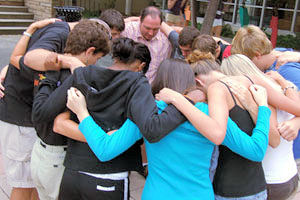
What Exactly Are Students Walking Away From?

We’ve all read the numbers.  We all get a little panicky when we think about how many students are walking away from church.  If the numbers are true, we’re facing a very serious problem because what we’re doing as parents and youth workers is not working.  We must grapple with one very difficult question:  why are students walking away from church after high school?

Maybe I’m over simplifying the issue but I think the answer is very easy.  Students aren’t walking away from church.  It’s not that the statistics are wrong.  Barna and Fuller have their numbers right.  That isn’t it at all.  And yet, I believe that students aren’t walking away from church.  They never belonged to church in the first place.  They’re walking away from something else entirely.


WHAT IS CHURCH?                                    

What is church?  That’s a really good question.  Personally, I think it’s best to define church by what I read in the New Testament.  Church is the Jesus community.  It’s a people bonded together by the presence, love and mission of Jesus.

The church is marked by the presence of Jesus.  There is something to be experienced in the church that cannot be experienced anywhere else.  The experience is different because Jesus is Immanuel.  The presence of God is with us.  Lives are being transformed.  Light is shining into darkness.  Life is breathed into death.  Hope is breaking forth in the midst of tragedy.

The church is defined by love.  The Jesus community shocked the world and overthrew an empire with love.  The Jesus community transformed the world in a few short centuries through inclusion, radical service, and care for the oppressed and forgotten.  Where the Gospel is preached and lived the world can never be the same.

The church is defined by the mission of Jesus.  The church is inviting people to follow Jesus.  It’s not asking people to join a club.  It’s not trying to fill seats in a building.  It’s inviting people to follow the most compelling person who ever walked the soil of this planet.  The church is inviting people into the restoration of the world through the Gospel of Jesus.


WHAT ARE STUDENTS WALKING AWAY FROM?

This is the church.  Students aren’t walking away from this.  People don’t walk away from the church.  It is far too magnetic.  The true church—defined by the presence, love and mission of Jesus is incredibly compelling.  It transforms lives, communities, cultures and nations.   Our students are walking away from something else entirely.

Maybe the problem is not that students are walking away.  In fact, they might be doing us a favor by pointing out the real problem.  Perhaps the problem is that we aren’t being the church.  Maybe we as parents, pastors and church leaders need to look in the mirror and ask ourselves some hard questions.  What exactly are we doing anyway?

 

How Love Overthrew an Empire

A few weeks ago we finished up a series on influence that we called Wakes.  I loved the imagery that Al, our production coordinator used for this series.  We borrowed (with permission) footage from a friend’s wake boarding Vimeo page and added text and music to it.  The combination of Johnny Cash and wake boarding ended up being pretty boss.  I was really happy with how the entire series turned out.

Wakes Bumper from LifeLine Student Ministries on Vimeo.


One of my favorite teachings from this series was on love and how the early Christians essentially overthrew a repressive empire without the use of force.  Check it out:


Wakes – Love from LifeLine Student Ministries on Vimeo.

Small Group Fail

Do you ever feel like you totally dropped the ball as a small group leader? I don’t mean those times where you go in for the appropriate side hug and get full-frontal attacked by a student, or the times you make some awkward comment to a 9th grade girl about her boyfriend without knowing they broke up two hours earlier. I’m talking about times that you flat-out fail on your own merit.

In case you hadn’t guessed, I am no stranger to those gut wrenching evenings of small group time where nothing is accomplished and the only one to blame is yourself. For me, I particularly get caught up in the “not being prepared” vain of failure. It’s not that I don’t think preparation is important, I just run out of time (so I tell myself). Annoyingly, I’ve discovered that when I do prepare, my small group is typically inattentive, and when I don’t they’re more ready to listen then ever—and I have nothing to say. Knowing I’m responsible for dropping the ball in those cases invites a very different feeling in me than when something I try simply doesn’t work. I’m sure you are all too smart for this, but I sort of have a tendency to beat myself up when this happens—because as the leader, I’m supposed to be the holy one, right? Not the unprepared, lazy kid. It’s in these moments that I think, “Who the heck let me in here?”

Yet when I have utterly botched up small group leadership and feel I am no longer worthy to be a leader, I remind myself of a few things. If you’ve ever been there, I invite you to scan this list as well. I know you already understand that God’s bigger than your stupid moments, but it’s good to be reminded. Here is my reminder list in times of failure:

You are not finished learning

No matter how long you’ve been leading a small group—whether it’s months or decades—you will never be a perfect leader. There will inevitably be days you’re not prepared, days you say the wrong thing, and days when no one responds to your questions or jokes. As it turns out, no matter how many people tell you you’re a great leader, you’ll never be done learning what that looks like. (There’s a head shrinker for you.)

The group isn’t lost

If you’re an invested leader who tries to build relationships and speak truth to students, one bad week won’t scatter the sheep. In youth ministry, we like to remind our leaders about how little time they have with their students because it’s good for them to feel urgency with kids they often see only 30 times a year (or less). But while it’s good to be reminded of how little time we have, it’s also good to keep in mind that one bad week is still only 3% bad in a year. The rest of the year could be 97% good! Don’t beat yourself up, just strive to grow toward that new 97% goal. (I guess you could strive for extra credit and take your kids out to ice cream too, but I’m not guaranteeing you’ll get your 3% back.)

Tell ‘em: adults mess up too

It’s easy to tell our small group kids that they need to own up to their messes (because let’s be honest, many of them have obvious messes to clean up). It’s a lot harder to admit that we screw up too. Talking about past mistakes you’ve grown out of is one thing, but admitting you still mess up is another. Yet I think if we miss out on these opportunities to tell our students when we drop the ball, we miss showing them what confession looks like. Some students may not have ever seen a real apology.

You screwing up is an opportunity to:

  • model what it is to ask forgiveness, even for something small
  • model humility as a leader

You’d be surprised how much respect you can gain by admitting you’re still not perfect. I mean, don’t make it a habit or anything, but a one-time screw up could actually draw your group closer to you.

So next time you don’t prepare, or you lose your temper, or you roll your eyes when you should’ve said something supportive, remind yourself of these things. And most importantly, keep going. Our enemy would like you to give up; God’s given you the grace to move forward. If you haven’t noticed, he’s pretty good at using imperfect people to turn out epic results.


Guest Blogger:  Elisa Talmage has spent over six years as small group leader of kids from 4th to 9th grade.  She is now on staff as the Female Small Groups Coordinator at Ada Bible Church and is currently pursuing a Master of Arts in Counselor Education. Elisa grew up in Cleveland, Ohio, where she and her husband met in fifth grade.


image credited to Chuckumentary

How to Pull off an Epic Volunteer Retreat

When it comes to pulling off an epic volunteer retreat, the key is understanding what it is that you want to accomplish.  Over the years, we’ve honed our focus down to three things. We want our volunteers to walk away from the retreat feeling connected, inspired and valued.  Our retreat is all about connecting volunteers to each other and to God, inspiring them to become the best volunteers they can be and valuing them for their uniqueness and their investment.

A KILLER THEME

We happen to believe that fun is spiritual and that taking the time to meticulously plan out a fun experience communicates value to our volunteers.  The key element of fun for us this year was our 80s theme.  Everyone came to the retreat dressed like it was 1983.  The soundtrack from the weekend was exclusively from the 80s.  All the games, prizes, decorations and snacks were from the 80s.  This theme added an incredible amount of fun and structured fun communicates value.

SONY DSC

COMMUNITY

Our goal is to weave community into every aspect of our volunteer retreat because we believe that volunteers who serve in community are better volunteers.  Because of this, we ask our cell families (teams of volunteers) to carpool and eat dinner together on the way to retreat.  We house each cell family together and build in cell family discussion in response to each session.  Aside from these elements, we believe that the very nature of getting away together as a community of leaders, staying up late playing volleyball or Setters of Catan, and eating meals together builds community.

GUEST SPEAKER

In our ministry context, we train our volunteers every other week.  Our volunteers hear from us a lot.  Because of this we will often bring in a guest speaker for our retreat simply because they bring fresh stories, language and perspective to the conversation.  This year we asked Brian, our Senior Pastor of Family Ministries and Ian Nacy, a local youth pastor to come and inspire our volunteers.

CONTENT THAT COUNTS

If you’re going to take the time to get your volunteers away, you should make it worth their while.  You need to communicate something valuable.  This year, our schedule included 3 sessions–two on Saturday and one long session on Friday night which included a 40 minute worship set.  If the retreat is all “fun” elements, your volunteers will be asking why they needed to come in the first place.

Here’s our schedule if you’d like to see it:  Retreat Schedule

THE VALUE PLAN

There are two ways to do a retreat.  There is the, “we have $5 to make this happen because we didn’t plan for it” and there’s the “we’re going to pull of an epic experience for our volunteers.”  We’ve found that it’s the little things that communicate value.  Choose a camp with nice facilities.  Tell the camp what meals you’d like to eat so you don’t end up with cafeteria corn dogs for lunch, bring great snacks, give away something big, put care into the programming elements and for crying out loud, don’t make your volunteers serve on their retreat.

LEAVE THEM WANTING MORE

In my opinion, one of the most important elements to a good retreat is when you end it.  It’s always tempting to try to do too much and keep your volunteers for too long.  We’ve struggled with finding this balance over the years but we’ve landed on this truth:  It’s always best to leave them wanting more.  If they can’t wait to come back next year then we’ve nailed it.

We start our retreat at 7:00 on Friday night and end it at 2:30 on Saturday afternoon.  It may seem to short but we don’t feel the need to cram hours of training into our volunteer retreat because we already train our volunteers every other week.


So, the key to an epic volunteer retreat is understanding what you want to accomplish.  For us, it’s all about connecting, inspiring and value.  What’s your goal and how do you achieve it?


Why Your Ministry Needs a Volunteer Retreat

Last weekend was our 17th annual volunteer retreat.  Ok, I actually have no idea how many retreats we’ve done but 17th annual has a nice ring to it.  Here’s the thing, of all the things we do in our student ministry, I believe that our volunteer retreat is in the top 3.  It’s crucial to our culture.  I can’t imagine not doing it next year and here’s why you should be putting one on too.

YOU NEED GREAT VOLUNTEERS

This year we set a new LifeLine record with 116 small groups so yes, we have a bunch of volunteers.  But here’s the thing, if you have more than 12 students, you need small groups and if you need small groups then you need volunteer leaders.  Not only do you need volunteers but you need great volunteers.  You need the kind of volunteers that you can trust to be spiritual shepherds to our students.  And, not only do you need great volunteers, you need great volunteers who will serve year after year because student ministry is a long-term investment.

So, how do you end up with great volunteers who stay engaged for the long-haul?  You invest in them.  A volunteer retreat is an incredible opportunity to invest deeply in your volunteers.  Here’s how it works.

VALUE

Here’s what I know:  volunteers who feel valued stay engaged in our ministry.  When volunteers understand, not only that we need them but that we enjoy them as people and value their individual gifting they tend to stick around.  We use our volunteer retreat to to create space for value conversations.  There is so much more that can be said on a weekend.

FUN

Volunteers who have a great time serving in student ministry tend to stay in student ministry.  If our volunteers are bored then we are seriously missing the mark.  We treat our volunteer retreat like a party.  Last weekend’s retreat included loud music, big prizes, crazy costumes, interactive games and hilarious videos.  If it isn’t fun you aren’t doing it right and your volunteers will likely go find someplace fun to serve.  Conversely, we’ve found that volunteers who have fun serving in our ministry stay engaged year after year.

SKILLZ

Nobody likes to suck at stuff.  This is a fundamental principle of humanity.  Student ministry is not an easy gig.  Leading a small group can be terribly difficult.  Volunteers who don’t feel like they are doing a good job will rarely stick around.  It’s our job as ministry leaders to equip them because volunteers who feel competent stay engaged.  We train our volunteers every other week but there is something special about getting away together on a retreat to really dig into core training concepts.

COMMUNITY

We are all hungry for community.  We believe that volunteers who have strong community make better spiritual shepherds for our students.  Some ministries require that their volunteers find a solid community, we build it right into our structure.  We have found that volunteers who connect deeply with other volunteers tend to stay engaged in our ministry for years.  For us, this is the biggest win of a volunteer retreat.  A weekend creates a ton of space for connecting.

GO AND DO

So, what’s the bottom line?  You should do a volunteer retreat!  Why?  Because we need great volunteers who stay engaged for years.  Volunteers who stay engaged feel valued, have fun, feel competent and serve in community.  A volunteer retreat is a great opportunity to invest in volunteers in each of these areas.

Tomorrow I’ll share some ideas on exactly how to pull off an epic retreat.

3 Levels of Belonging

Our student ministry does something that I believe is rather unique.   We call it cell family and we stole the idea wholesale from a church across town about a decade ago.  They stopped doing it years ago and we’ve been dumb enough to stick with it.  And yet, we’ve come to love it and it’s become an indispensable part of who we are as a ministry.  What exactly is cell family? I’m glad you asked.

ONE EPIC NIGHT OF AWESOMENESS

Our high school ministry meets on Sunday nights.  We built our ministry around small groups and we’re one of those student ministries that attach our small groups to our programming.  In other words, we pack everything into Sunday nights:  hang out, games, worship, teaching and small groups.  We always leave the last 30 minutes of our night to small groups.  We believe this is the best model for student ministry for a variety of reasons but we can argue about that in another post.

CELL FAMILY

What makes us unique is that every other week we meet in homes.  Instead of meeting all together with all of our students and volunteers, we meet in regional homes based on school.  We don’t add another night of programming, we do cell family in place of our regular large group programming.  Sound like a logistical nightmare?  It is.  But to us, it’s worth it.

THREE LEVELS OF CONNECTION

There are a few reasons we believe this model is strategic. First off, we believe that students need to know and be known.  Our dream is that students would know be known by ten adult volunteers (each cell family has 10 volunteers in it).  These volunteers know each student’s name and basic story.

We also want each student to experience three levels of belonging.  We want them to belong to something big.  There is something special about worshiping together with hundreds of people.  We also want our students to belong to something small.  Small groups are the place where they can be vulnerable and real.  It’s the environment in which they can be cared for and led by an invested adult.

Lastly, we believe our students need to belong to something midsize.  We believe that there is something valuable in 30 or 40 people in a house.  It feels a bit like a family reunion.  It’s a support network.  It’s a place where younger students can observe the faith of older students and where volunteers can show students what healthy relationships look like.  It’s a place for students to try out their gifts and talents and it’s a place where they can have a voice.

INTERACTIVE TEACHING

Cell family is also a response to how students learn.  We believe that students retain information best when they are able to interact with it as it is presented.  In our cell families, we teach through discussion rather than preaching.  Instead of a 20 minute presentation, we produce a 7 minute teaching video that leads into a group discussion.  We believe this model of communicating better fits how our students learn.

SERVE AS A FAMILY          

The last and perhaps most important reason we do cell family is volunteer community.  We believe that volunteers are at their best when they are serving as a family.  Each cell family is composed of 6-8 small group leaders and two volunteers that oversee the cell family.  These “coaches” as we all them have two roles:  care for their small group leaders and oversee the cell family programming.

Each time we meet in cell family, the volunteer team meets an hour early and has dinner at the cell family home.  Over time, the combination of these meals and serving together leads to fantastic volunteer community.  We want our volunteers to feel supported and together and cell family is a huge reason why we’re able to achieve this.


So You Wanna Work at a Mega Church…

Whenever I interact with student ministry workers from other churches the inevitable question awkwardly slips out, “So…how big is your youth group?”  When I answer, some people get this wanting look in their eyes as if I am describing what it was like to eat Filet Mignon at a restaurant they’ll never be able to afford.  I know exactly what this is about.  I used to have mega-church envy myself.  Those flashing lights, the stage sets and ginormous crowds mesmerized me.  Then God smiled upon me and scored me a job at a mega-church.  At least, that’s how my thinking went at the time.  Now I understand that student ministry is student ministry and there are a fantastic and lame things about working in a small or large environment.  Here’s a little of what I’ve learned.


Working Directly With Students

As a student pastor in a smaller church I constantly interacted directly with students.  I love students.  I love learning about their world and doing my best to counsel and mentor them toward Jesus.  Working in a small church, this was my primary role.

As a student pastor in a mega-church my role changed dramatically.  My direct interactions with students dropped sharply.  I discovered that in a mega church environment students want to hang out with their small group leader instead of me.  I went from being extremely sought after to “that weird guy in the announcement videos.”


Working on a Team

In a smaller church, my student ministry staff (me and…me) always loved my ideas and were quick to support and implement them.  Sure we occasionally made bad decisions but we were able to implement our ideas quickly.

One of the first things I discovered about working within a student ministry team is that people don’t always love my ideas.  In fact, sometimes they hate them.  In a mega church with multiple staff I have to do really annoying things like defend my ideas and demonstrate why new programs or events are good ideas.  I hate this sort of thing.  When will everyone realize that I’m a genius and just blindly follow me?


Variety vs. Specialization

I get bored easily.  I love having multiple projects spinning at once so that when I lose interest in what I am doing  I can jump to another project.  As a student pastor in a smaller church, I was responsible for just about everything.  I was the teacher, strategist, planner, worship leader, mentor, volunteer coordinator…those of you who work in a smaller environment know exactly what I’m talking about.  I loved the variety.

In a large student ministry, there are experts who work in each realm of ministry and I only get to do one or two.  And by experts, I mean that they possess far more knowledge and skill than me.  I have become much more proficient in my areas of responsibility because of my work experience on a team of experts but sometimes I get bored.


The Spotlight 

In a smaller church you are “the” youth pastor or at least the middle school or high school pastor.  In other words, you are in the spotlight.  When things go well people love you.  When things go wrong you’ve got some explaining to do…at the board meeting.

As part of a student ministry team in a mega-church, the spotlight doesn’t often find me.  When things go wrong, the team often shares the blame.   Conversely, when something goes well in our ministry the person who gets credit is typically my boss.  Honestly, most people in our congregation don’t have a clue who I am.

So that’s a taste of what it’s like to work in a smaller church and a mega-church. Student ministry is student ministry.  There are pros and cons to smaller and larger environments.  Feel free to add to my list.


image credited to cubedude27

Volunteer Pep Talk | Growth

It’s Wednesday night and you’re attempting to lead your small group.  As you look around, two small groups are deep in prayer and one is passing out tissues because Sally is pouring her heart out.  You’re startled back to reality by a flash across your field of vision as Billy catapults himself off the top of a nearby couch and drops a well placed elbow into Johnny’s lower back.  Yes, this is your small group.  While the groups around you are engaging in community and discipleship, your group is engaged in a WWE cage match…again, just like they do every week.  And you ask yourself, “Why am I even here?”

This week, I’m blogging about and for student ministry volunteers.  Here’s yesterday’s post, if you’re interested.

Sometimes, actually many times, it doesn’t feel like we are getting anywhere with students.  In these moments it’s important to remember what we’re called to do and what we’re not called to do.  In these moments, a little gardening tip can keep us sane.

SEEDS AND WATERING CANS

As we think about leading students this year, there is a principle found in 1 Corinthians that has kept me sane in many difficult moments in student ministry.  Check it out:

“I planted the seed, Apollos watered it, but God has been making it grow.  So neither the one who plants nor the one who waters is anything, but only God, who makes things grow.  The one who plants and the one who waters have one purpose, and they will each be rewarded according to their own labor.  For we are co-workers in God’s service; you are God’s field, God’s building.”                              (1 Corinthians 3:6-8)

Paul is describing the growth of the Christians in Corinth.  He was the one who planted the seeds.  He preached the Gospel to the people in Corinth.  For most, he was the person who introduced them to Jesus.  Then, Apollos came and taught them more about what it looks like to follow Jesus.  They grew and became more established under Apollos’ teaching.  And yet, Paul acknowledges that while they both had critical roles, God is the one who made the people grow.  Paul and Apollos were simply being faithful to their calling.

OUR ROLE AND GOD’S ROLE

As much as we try in student ministry, we cannot cause growth.  Only God can do that.  We can only be faithful with the roles that God has given us.  I love this. There is freedom and clarity here.  I can build relationships.  I can pursue students.  I can speak truth and I can love students well.  But, I cannot produce the results.  I cannot make a student grow.  That’s God’s role.

So this year, be a great small group leader.  Mentor your students.  Love them well and show them how to follow Jesus.  As you do these things, remember that it’s God’s role to make them grow.  Plant seeds like crazy and go nuts with the watering can.  Do your very best to love students and draw them into what Jesus is doing in and around us.  But, at the end of the day, breath a sigh of relief because, ultimately, it’s God’s role to make students grow.  All you can do is be faithful.

To Our New Volunteers

It’s September, that means it’s time to launch our student ministry.  This week I’m focusing my blog on volunteers.   Here’s what I shared with our brand new volunteer small group leaders last Wednesday night…

Sometimes you guys make me mad.  I’ll be honest, sometimes I get a little jealous.  Why?  Baptisms.  Yeah, that’s right.  Baptisms.  You see, when we do baptisms in high school, our students share their faith stories and talk about the influential moments along the way.  You know what they never say?  They never say, “I really remember this one time when Aaron was teaching and he said ….”  They never say that, because they basically never remember ANYTHING we say from the stage.  They really don’t.  It’s kind of depressing actually.

You know what they do say at baptism night?  Standing there in the hot tub they unfold their papers and read aloud about how influential their leader has been in their life.  They talk about…

  • how their leader put up with them when all they did was scream or wrestle in 6th grade
  • that trip they went on with their small group or that week in a cabin at Camp LifeLine
  • a tearful conversation in 9th grade after that really bad decision when their leader was there for them and comforted them
  • countless trips to Starbucks in which their leader poured into them
  • solemn small group moments at 2am on our senior sneak trip, long after all the tissues in the hotel room have run out.

When it comes to the baptism faith stories, you guys get all the credit and honestly, that’s how it should be.  You guys are the pastors in this ministry.  You are the spiritual shepherds.  You are the backbone of this ministry and we appreciate and need you deeply.

PASTORS AND SHEPHERDS

Please understand how important you are to the spiritual growth of our students.  It will be your role to know our students–their families, situations, struggles and strengths.  You will be there for them in the difficult moments.  You will laugh with them in the hilarious moments.  You will speak truth into their lives when they need to hear it.  You will walk with them and watch them grow into the people God is calling them to be.

Without you and what you do our ministry is ineffective.  Honestly.  We’re so grateful for you and want to encourage you to embrace your role as pastors and shepherds in the lives of our students.

HOW DO YOU GET THERE?

Here you are, a brand new leader in LifeLine.  I know you all want to do an amazing job this year.  So, how do you get from uncertain noobie to sharing stories in the baptism tub?  How do you have that kind of impact?  It’s actually really simple.  If you break it all down it’s this simple:

Follow my example, as I follow the example of Christ. (1 Corinthians 11:1)

Follow Jesus in front of them.  Invite them into your life.  Share the crucial stories from your life in which God made His presence and purposes known.  Talk to them about your mistakes and how God grew you through them.   Show them and lead them.  It’s not easy but it’s simple.   You are the pastor.  You are the shepherd.


photo credited to j.minor

The Cost of Leadership

My boss, Brian, has a saying that goes like this:  “Leadership is a series of losses.”  Like usual, the first time I heard him say it, I had no idea what he was talking about.   But over time, I’ve come to see that he’s got a genius streak.  Let me explain.

A few months I ago I received a promotion.  I was given more oversight, more responsibility and new roles.  Of course, getting promoted is a good thing and feels very nice.  I also love the idea of providing vision and oversight to the ministry.  However, I’ve learned that promotions aren’t all smiles and sunshine.  In fact, I’ve been mourning this transition for a few weeks now.

You see, I’ve spent the last five years building things.  Some of these things I’m very proud of.  About 50 adult volunteers make our high school ministry what it is.  It’s been my privilege and responsibility to recruit, train and walk with these volunteers.  I was the one who interviewed them, chose their small group and helped them find their way in the early days of volunteering.

I care deeply about each one of them.  We’ve walked through some heavy stuff—student and family crisis, personal loss, feelings of inadequacy, and relational conflict.  I also feel a strong sense of pride in knowing that I’ve had a role in equipping them.  But, it’s no longer my role to equip them.  I am losing this role.  It’s time to hand it over to someone else.

Over the last 3 years, I’ve built a high school to college transition program that I love.  At the risk of sounding like a regular jackwagon, I’m incredibly proud of this ministry.  I love it because it’s unique and effective.  My greatest joy in ministry over the last 3 years has been watching graduates of our ministry thrive in college and adulthood.  Knowing I’ve had even a small role in their growth is very rewarding.  But, with my new position, I won’t be able to lead this program any longer.  I am losing this role.  It’s time to hand it over to someone else.

For the last 12 years, I have been leading worship in student ministries on a regular basis.  I absolutely love playing music and drawing students into the presence of God.  I can’t imagine not leading worship.  And yet, it’s no longer my job to lead.  I’m losing this role.  It’s time to hand it over to someone else.

Please understand that I’m very happy about my promotion and I’m excited and honored to lead our high school ministry.  I feel this is exactly where God wants me and I know that it’s right but I have to be honest about the cost of leadership.  It’s terribly painful to build something and then hand it over to someone else and trust them to do the work.  Leadership costs something.

Moving up in an organization always leads to greater leverage and lesser contact.  5 years ago I left behind the role of everyday contact with high school students.  It was a painful but ultimately good transition.  And now, as the leader of our high school ministry, I have been gifted with the leverage to direct the entire ministry and yet, I know I will have less contact with our students and volunteers and less contact with some of the roles and programs I have loved over the last few years.

In this way, leadership is a series of losses.  I must let go of what I love and learn to empower others to take what I have built and transform it into something that is uniquely theirs.  Have any of you had this experience?